
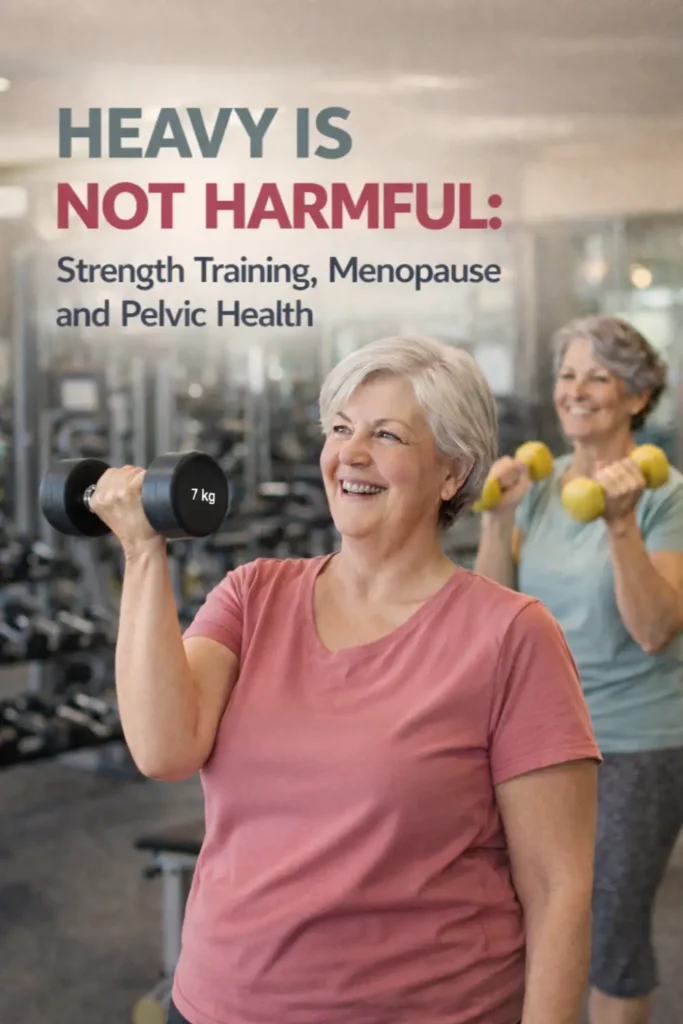
If you haven’t read about the importance of strength training for women of menopausal age and beyond, where have you been? It’s a hot topic at the moment, and for good reason.
Still on the fence? Let us try to convince you.
Debunking the Myths
Right then, it’s time to debunk some myths around strength training and pelvic health. If you’ve ever consulted the internet for an opinion on the safety of lifting weights with a prolapse, or after gynae surgery for example, you’ll probably have encountered one of the following:
- Never lift anything heavier than a bag of sugar, ever again
- Lift as heavy as you like and don’t worry about it
These are the two extreme ends of the spectrum, and both are damaging in different ways.
The “Never Lift Anything Heavy” Myth
This advice comes from a well-meaning place, but it’s deeply unhelpful. The idea is that if women never lift anything, they’ll never put pressure through their pelvic floor which could worsen symptoms.
The reality? This approach is far more harmful than protective. By avoiding all resistance training to protect the pelvic floor, we sacrifice muscle mass, bone density, cardiovascular health, metabolic function and mental wellbeing. These consequences are far more serious than the original pelvic health concern. That’s not a trade-off worth making.
The “Lift Heavy Without Thinking” Myth
I appreciate the sentiment here—there’s something refreshing about throwing off the shackles of overcaution. But this approach can be problematic too.
If we have a woman who is more vulnerable from a pelvic health perspective and we launch her straight into an ill-thought-out exercise routine, she may well aggravate her symptoms. This becomes a self-fulfilling prophecy: she loses confidence and stops training altogether, which then genuinely does risk her health.
The Facts About Exercise and Your Pelvic Floor
As you probably know (especially if you’re already our patient), your pelvic floor is a sheet of muscles sitting at the bottom of your pelvis. It supports your pelvic organs and plays crucial roles in bladder and bowel control, sexual function, and managing intra-abdominal pressure alongside your diaphragm and core muscles.
The pressure within your abdomen naturally increases when you cough, sneeze, strain or lift heavy things. This is completely normal, and our bodies are remarkably clever at managing this without conscious thought. This means that most people can lift heavy weights without putting undue pressure on their pelvic floor.
However, some women may have factors affecting their anatomy or muscle control that means they don’t manage that pressure quite as efficiently. This might include:
- Hypermobility
- A traumatic vaginal birth
- Pelvic organ prolapse
- Previous gynaecological surgery
- Stress incontinence
- Significant diastasis recti
Here’s the crucial bit: This doesn’t mean someone with one or more of these factors cannot lift weights. It simply means their programme may need adapting to suit them.
Why Strength Training Is Non-Negotiable for Menopausal Women
Here’s something to consider: when you’re training, are you aiming to be a really fit, active 90-year-old? No? Maybe it’s worth a thought. Great ageing doesn’t happen by accident.
The statistics are clear—the more muscle mass you have going into older age, the less severe your functional decline will be. We can’t stop ageing, but we absolutely can influence how we age. The strength you build now is your insurance policy for maintaining independence, mobility and quality of life decades from now.
Let’s look at what the research actually tells us about strength training during and after menopause:
Bone density: Resistance training is one of the most effective interventions for maintaining and even building bone density. During menopause, oestrogen decline accelerates bone loss. Weight-bearing and resistance exercises create the mechanical stress bones need to stay strong. This isn’t negotiable if we want to reduce fracture risk as we age.
Muscle mass and strength: After menopause, the rate of muscle loss accelerates. Strength training is the only way to counteract this. More muscle means better functional capacity—carrying shopping, lifting grandchildren, getting up off the floor, maintaining independence.
Metabolic health and body composition: Resistance training improves insulin sensitivity and helps maintain a healthy metabolic rate. With the metabolic shifts that occur during menopause, this is vital for managing weight and reducing diabetes risk.
Joint health: Strong muscles protect joints. This is particularly important as oestrogen decline can affect connective tissue health. Proper strength training, far from damaging joints, actually protects them.
Mental health: Multiple studies show that resistance training reduces symptoms of anxiety and depression, improves sleep quality, and boosts self-efficacy. These psychological benefits are every bit as important as the physical ones.
The Middle Ground: Smart, Progressive Strength Training
So where does this leave us? Right in the sensible middle ground.
The answer isn’t to avoid lifting weights because you have a pelvic health concern. The answer is to lift weights intelligently, with appropriate support and progression.
Learning to breathe through lifts rather than holding your breath, and managing intra-abdominal pressure effectively, is a skill we teach you along the way. We’re not ignoring your pelvic health—we’re paying close attention to it. If exercises consistently aggravate symptoms, we modify. But we don’t throw the baby out with the bathwater.
For some women, there may be a period of targeted pelvic floor rehabilitation before progressing to heavier loaded exercises, and that’s completely fine. This isn’t a race.
Your Pelvic Floor Isn’t Fragile
Here’s perhaps the most important message: your pelvic floor is not made of glass. It’s made of muscle. Muscles are designed to work, to be challenged, to adapt and strengthen.
Yes, some women need more careful programming than others. Yes, pelvic health conditions require specialist input. But the solution is almost never to avoid strength training altogether—it’s to do it well, with proper guidance.
The risks of not strength training far outweigh the risks of doing it sensibly. We’re not just talking about pelvic health here—we’re talking about your bones, your heart, your brain, your independence, your quality of life as you age.
Where to Start
If you’re experiencing pelvic health symptoms and you’ve been avoiding strength training because you’re worried about making things worse, please don’t let fear hold you back from something that could genuinely transform your health.
Seek out a specialist pelvic health physiotherapist and a personal trainer (yes, that’s us) who can assess you properly and give you an accurate understanding of what’s going on.
Heavy is not harmful. Done right, it’s protective, empowering, and utterly transformative.
Your future self will thank you for starting today.